
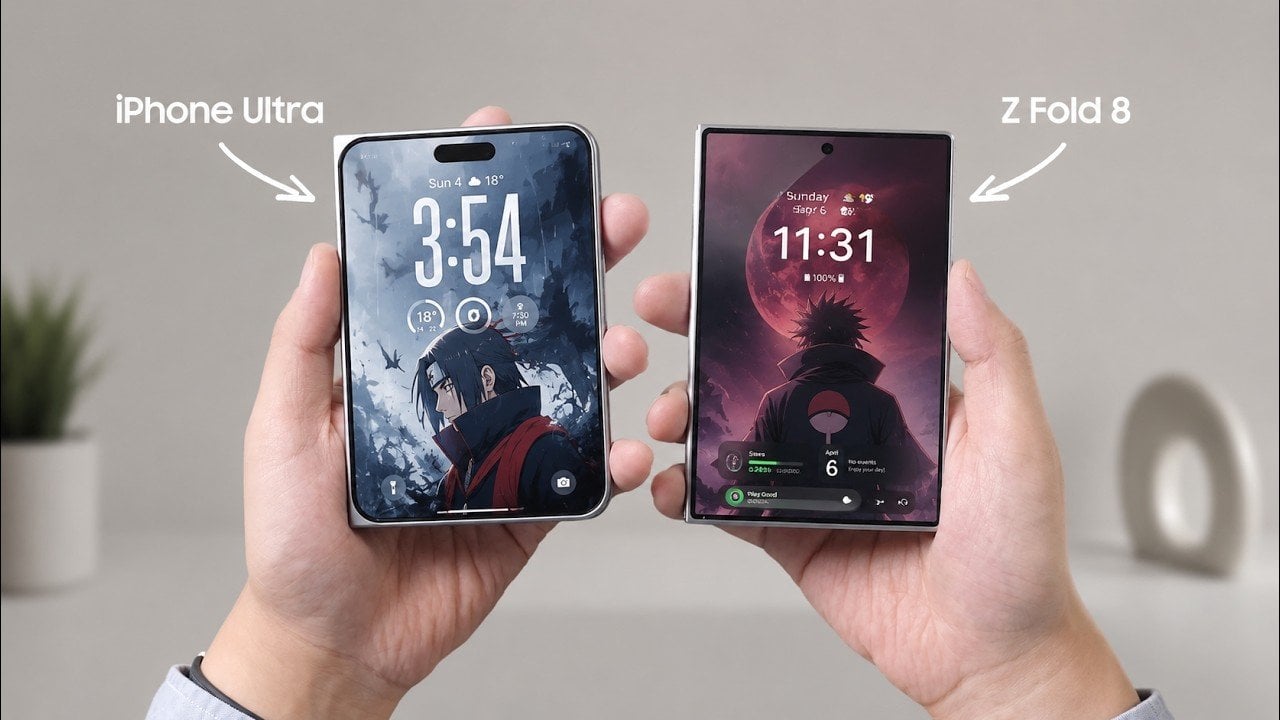
Samsung has introduced two variations of its latest book-style foldable, the Galaxy Z Fold 8 and the Galaxy Z Fold 8 Ultra, each targeting different user preferences. While both devices share the same core hardware platform, including the Snapdragon 8 Elite Gen 5 for Galaxy processor and up to 16GB of RAM, they diverge significantly in physical design and intended use cases.
The Galaxy Z Fold 8 Ultra adheres to the established foldable formula, featuring a tall 21:9 cover display that mimics a traditional smartphone experience. This model is designed for users who want a familiar interface that unfolds into a large, square-like inner screen. It also retains advanced features like Flex Mode, which allows the device to remain stable at various angles for hands-free photography, supported by a 200MP primary camera and a dedicated 10MP 3x telephoto lens.
In contrast, the standard Galaxy Z Fold 8 adopts a more compact approach with a shorter 16:10 cover display and a wider 4:3 inner screen. This design is intended to feel more comfortable for one-handed use, though it lacks the hinge stability required for the full Flex Mode experience found on the Ultra. The camera system on the standard model is also more streamlined, featuring a 50MP primary sensor without a dedicated telephoto lens, relying instead on digital zoom.
Multitasking workflows also differ between the two models due to their respective aspect ratios. The wider inner display of the Galaxy Z Fold 8 allows for side-by-side app windows that are less narrow than those on the Ultra, potentially offering more practical space for certain productivity tasks. Conversely, the Ultra model utilizes a more traditional layout that prioritizes a primary app window alongside two smaller ones.
Both devices feature significant engineering updates, including IP48 water and dust resistance and silicon-carbon batteries. The Galaxy Z Fold 8 Ultra includes a 5,000mAh battery, while the standard Fold 8 uses a 4,800mAh capacity. Both support 45W wired charging and 20W wireless charging. Samsung has also committed to seven generations of Android OS upgrades for the series, aiming to provide long-term value for users investing in these premium devices.